Choose a lead product
Begin with the romper, pajama or bodysuit most important to your customer, then add only styles that share a clear material and color direction.

LOW MOQ · PRIVATE LABEL · OEM & ODM
RUIXING helps US startups and growing brands develop custom bamboo rompers, fitted pajamas, bodysuits and sleep products without starting with an oversized collection. Build the first order around a clear product brief, approved sample and realistic material plan.
Request a low-MOQ quotation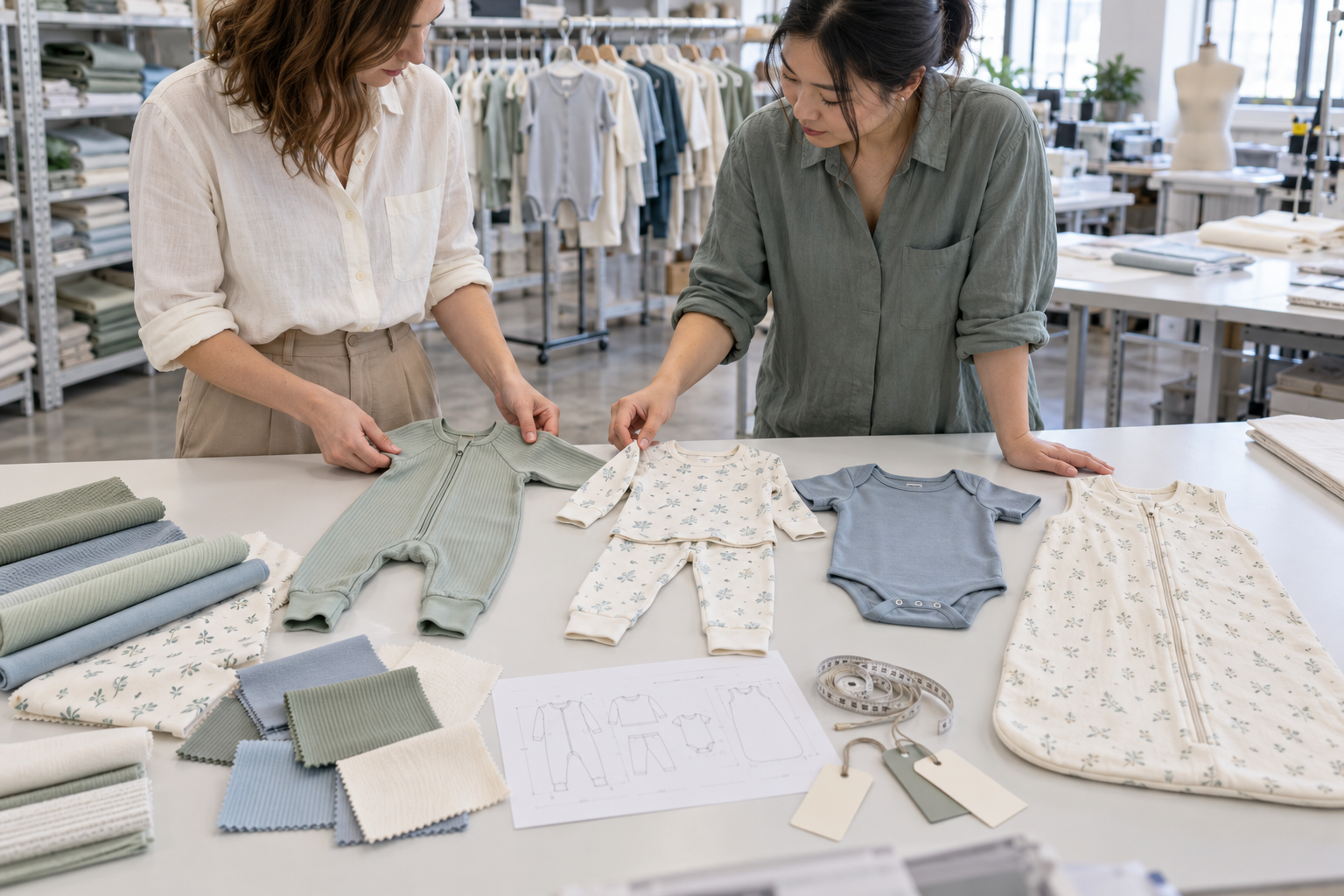
FOR STARTUPS AND TEST ORDERS
MOQ is not one fixed number for every garment. Available fabric, custom dyeing or printing, zipper and trim minimums, size ratios, labels and retail packaging all affect the smallest practical run. A useful quotation separates these factors instead of promising an unrealistic quantity before the product is defined.
For a first launch, a focused capsule can protect design intent while reducing unnecessary setup: use one approved fabric across compatible styles, limit colorways, share suitable trims and finalize packaging before sampling.
Begin with the romper, pajama or bodysuit most important to your customer, then add only styles that share a clear material and color direction.
Using the same approved jersey or rib across compatible garments can reduce fragmented material purchasing and improve collection consistency.
Connect the approved sample to its measurements, artwork, color, label positions, construction notes and packing instructions.
Record repeatable specifications and separate permanent core details from seasonal prints so successful styles are easier to reorder.
WHAT CHANGES THE MOQ?
Send the same scope to each supplier. A lower number is not comparable if the fabric, customization or packaging assumptions are different.
MOQ BY STYLE, COLOR & SIZE
A low MOQ baby clothing manufacturer needs to know how your total divides into production groups. Two styles in two prints create four style-and-print combinations, not one production group.
For example, 100 garments split evenly across two styles and two prints leave 25 garments in each combination. If a supplier requires 50 per style-and-print combination, that plan would require 200 garments. This is an arithmetic illustration, not a RUIXING quotation or a confirmed production minimum.
Send one row for each style, color or print, then list the quantity in every requested size. Check that all size quantities add up to the row total and that all row totals match your purchase order. Use your own sales evidence for the size ratio; an equal split is not a demand forecast.
WRITTEN QUOTATION CHECK
Before placing a deposit, compare the same specification and quantity matrix with each supplier. A low unit price is not the full launch budget.
Use our baby romper quotation comparison guide alongside the private-label development checklist.
US PRODUCT PLANNING
Children's products sold in the United States generally require third-party testing to applicable children's product safety rules and a Children's Product Certificate. The finished product, intended age group, materials and classification determine which requirements apply.
Tracking information should also be planned for the product and packaging. For children's sleepwear, classification matters: garments above size 9 months through size 14 may need to meet the sleepwear flammability standards or the defined tight-fitting dimensions. Beginning July 8, 2026, importers of most regulated consumer products are also required to electronically file certificate data with US Customs and Border Protection.
BUYER QUESTIONS
Ask for the basis in writing. Our typical starting point is 50 pieces per style, but this does not automatically mean that any number of colors, prints or sizes can be combined. The quotation should state the minimum for each style and color or print, the permitted size split, and any separate material or packaging minimums.
A size split can be reviewed with the product brief. Provide a quantity matrix by style, color or print, and size rather than only an order total. Confirm the accepted size ratio and any minimum per size before approving the order.
Agree this in the quotation or purchase order. Ask whether surplus materials are included in your price, who owns them, whether storage is offered, how long they can be held, and whether they can be used for a reorder. Do not assume that paying a setup fee includes ownership or indefinite storage.
Our typical starting point is 50 pieces per style. The practical MOQ depends on fabric availability, custom color or print method, trims, size ratio and packaging, so we confirm it after reviewing the full product brief.
Yes, when the collection is planned carefully. Reusing an approved fabric, coordinating colors and limiting unique trims can make a small capsule more practical than developing every style with unrelated materials.
Private labels, care labels, hangtags and packaging can be included. Their own supplier minimums and setup costs should be reviewed separately from the garment quantity.
A standard sample is typically completed in approximately 3–7 days after the fabric, artwork, measurements and construction are confirmed. Custom knitting, dyeing or printing can require additional time.
We can help organize product information and coordinate third-party testing for the applicable product plan. The US importer or domestic manufacturer is responsible for determining applicable rules and issuing the Children's Product Certificate based on compliant test results.
Review our private-label service for US brands, US baby clothing compliance guide, bamboo babywear manufacturing capabilities, custom romper development, OEM and ODM process, and MOQ and sampling guide.
Send your quantity and product brief